
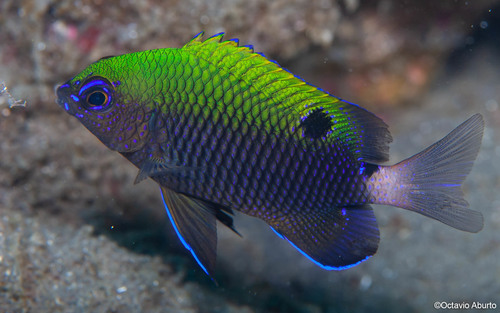
Chopita de Cortés (Stegastes rectifraenum )
Es una especie endémica de México, lo que significa que de manera natural vive en esta región y no tiene poblaciones silvestres en otras partes del mundo.
Los adultos suelen ser café oscuro, mientras que los juveniles pueden tener colores azulados y brillantes.
¡Y aquí viene lo más divertido! La chopita es una especie de “jardinera submarina”: mantiene un pequeño territorio donde deja crecer algas que le sirven de alimento y lo defiende de otros animales. ¡Es como tener un huerto bajo el agua y gritar: “¡Este jardín es mío!”!












Moreno-Sánchez, Xchel & Abitia, Andres & Escobar-Sánchez, Ofelia & Palacios-SalgadoDeivis. (2011). Diet of the Cortez damselfish Stegastes rectifraenum (Teleostei: Pomacentridae) from the rocky reef at Los Frailes, Baja California Sur, Mexico. Marine Biodiversity Records
Fischer, Walter & Krupp, Friedhelm & Schneider, Wolfgang & Sommer, Corinna & Carpenter, Kent & Niem, Volker. (1995). Guía FAO para la identificación de especies para los fines de la pesca, Pacífico centro-oriental; vol. 3.
Olivier D, Lepoint G, Aguilar-Medrano R, Díaz AHR, Sánchez-González A, Sturaro N. Ecomorphology, trophic niche, and distribution divergences of two common damselfishes in the Gulf of California. C R Biol. 2019 Nov-Dec;342(9-10):309-321
Petersen, C. W., & Marchetti, K. (1989). Filial cannibalism in the Cortez damselfish Stegastes rectifraenum. Evolution, 43(1), 158–168.
Hoelzer, G. A. (1990). Male-male competition and female choice in the Cortez damselfish, Stegastes rectifraenum. Animal Behaviour, 40(2), 339–349
Shorefishes of the Eastern Pacific. (s. f.). Stegastes rectifraenum, Cortez damselfish.Smithsonian Tropical Research Institute.
Aguilar-Medrano, R., Kobelkowsky, A., & Balart, E. F. (2015). Anatomical description of the Cortés damselfish Stegastes rectifraenum (Perciformes: Pomacentridae): Key structures for omnivore feeding. Revista Mexicana de Biodiversidad, 86(4), 934–946.