
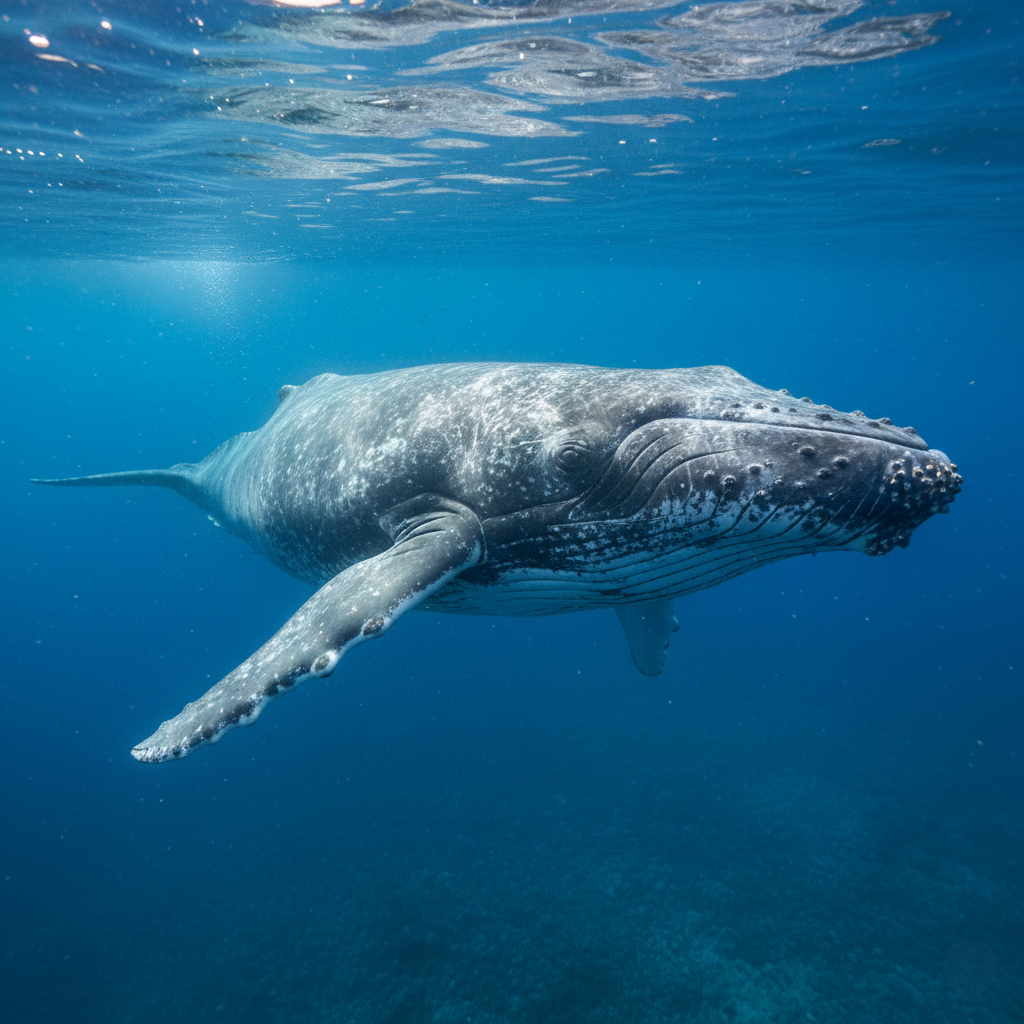
Ballena Gris (Eschrichtius robustus)
Soy un mamífero marino, como los delfines y las focas: respiro aire, amamanto a mis crías y tengo sangre caliente. Mi cuerpo es largo y fuerte, gris con manchas blancas, y a menudo estoy cubierta de parásitos marinos, como balanos y piojos de ballena, que me dan un aspecto rugoso.
Aunque no tengo dientes, en mi boca llevo unas barbas que parecen cepillos colgantes hechos de queratina, el mismo material de tus uñas. Estas barbas me ayudan a filtrar mi alimento del agua.










Bibliografía
• Jones, M. L., Swartz, S. L., & Leatherwood, S. (2015). The gray whale Eschrichtius robustus. Academic Press. • Mate, B. R., Lagerquist, B. A., & Irvine, L. M. (2011). Feeding habitats, migrations, and seasonal distribution of North Pacific gray whales. Journal of Cetacean Research and Management, 13(1), 31–39. • Nerini, M. K. (1984). A review of gray whale feeding ecology. In The gray whale: Eschrichtius robustus (pp. 423–450). Academic Press. • Sumich, J. L., & May, M. A. (2009). Scaling and mass estimation of a female gray whale (Eschrichtius robustus) based on photogrammetry and morphometrics. Marine Mammal Science, 25(4), 827–838. • Swartz, S. L., Martínez, A., Urbán, J., Gómez-Gallardo, A., Salinas, Z. M., & Rowntree, V. J. (2006). Gray whale migrations and reproductive biology in Baja California lagoons. U.S. National Marine Fisheries Service. • Urbán, J., Gómez-Gallardo, A., Flores‑de‑Sahagún, V., Cifuentes‑L, J., Ludwig, S., & Palmeros, R. (2003). Large aggregations of mothers with young and courting/mating whales in breeding areas. En C. J. Salvadeo et al., Climate change and grey whale biology (pp. 998–999). Serbio Soc. • Weller, D. W., Burdin, A. M., & Reeves, R. R. (2002). A gray area: uncertainty about the status of western North Pacific gray whales. The Gray Whale: Eschrichtius robustus (pp. 519–537).